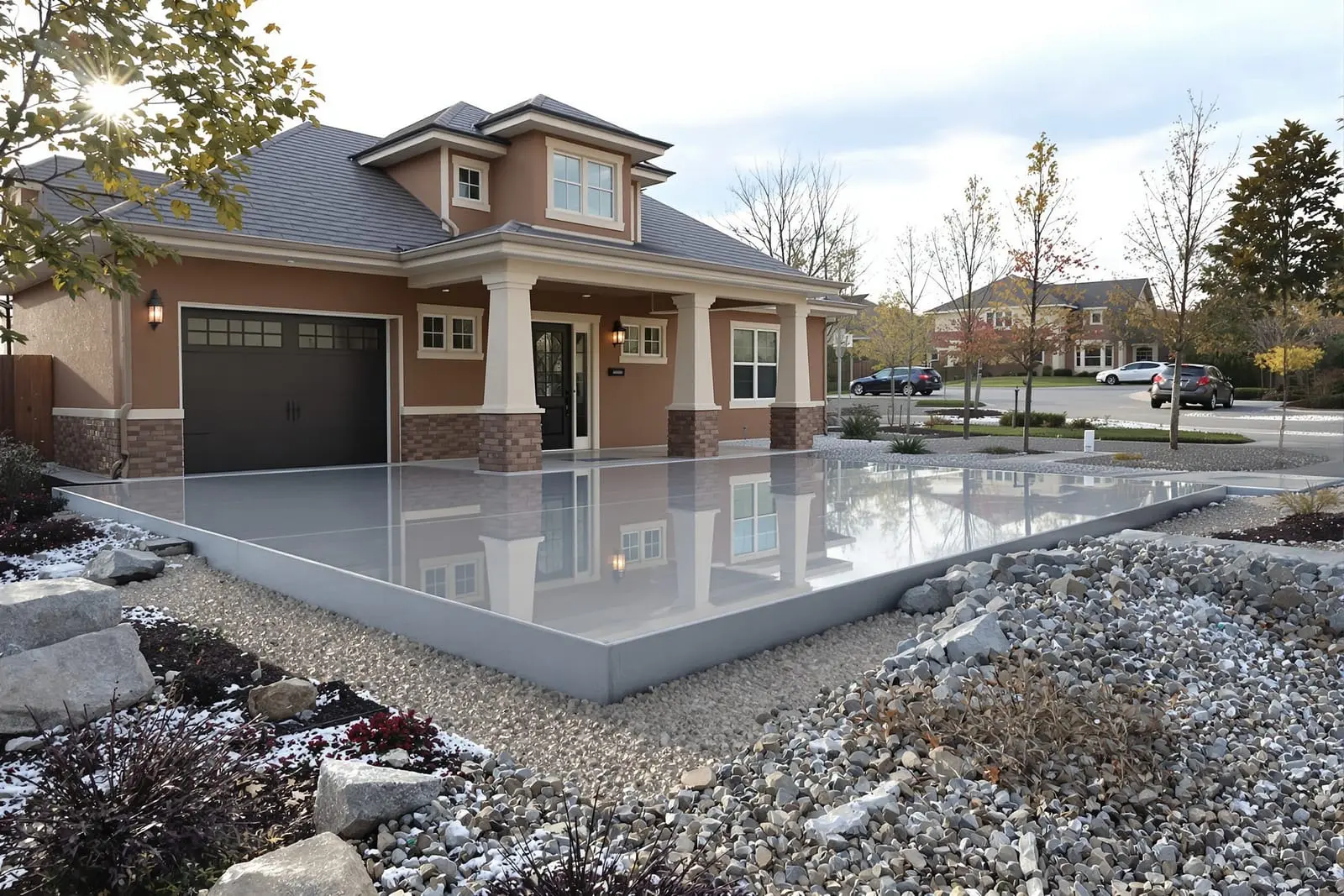
Keep your project moving with commercial concrete flatwork in Omaha, NE. We pour interior and exterior slabs, equipment pads, and aprons with the finish you need. From laser screeded warehouse floors to broom finished exterior panels, our crews deliver quality and consistency.
Primetime Concrete Omaha provides professional commercial concrete flatwork throughout Omaha, NE and the surrounding area. Our licensed, insured crew delivers safe, clean, on-time work with a free estimate before anything begins. Call (402) 838-2266 or request your free quote.
Commercial Concrete Flatwork Built for Omaha Conditions
Primetime Concrete Omaha installs commercial slabs and flatwork that are sized and reinforced for the actual traffic, equipment, and freeze–thaw cycles your property deals with in Omaha. We focus first on how the slab will be used, so the mix, thickness, reinforcement, and joint layout match your real loading needs, not a one-size-fits-all spec.
For light commercial use like retail sidewalks, dumpster pads, and patio seating, we typically recommend 4 to 5 inch slabs with fiber-reinforced concrete and properly spaced control joints. For drive lanes, loading docks, and warehouse floors with forklifts or pallet jacks, we move into 6 to 8 inch slabs, higher psi mixes, and rebar or dowel baskets where the loads are highest.
Local temperature swings in Omaha can crack or heave slabs that are not detailed correctly. We account for frost depth, drainage, and snow removal practices when we design commercial concrete flatwork, so your surface does not spall or lift after a couple of winters. Our crews work across Omaha and the suburbs year round, so we know how to adjust placement, curing, and protection for both summer heat and winter cold.
If you need an engineered slab, such as for a new commercial building or a heavily loaded equipment pad, we work directly from your structural drawings and coordinate with your engineer as needed. If you do not have plans yet, we can provide practical recommendations based on typical loading, subgrade conditions, and local codes in Omaha and Douglas County.
How We Install Durable Commercial Slabs & Flatwork
Every commercial concrete flatwork job for Primetime Concrete Omaha starts with an on-site visit. We look at existing grades, access for ready-mix trucks, drainage patterns, and any nearby structures or utilities. For replacements, we inspect cracks, settlement, and joint failures in your existing slab to understand what went wrong and how to prevent it on the new pour.
Site prep is where most long term failures start. We strip soft topsoil, organics, and debris, then compact the subgrade using plate compactors or rollers depending on the area. In many commercial jobs we add and compact a layer of crushed rock, commonly 3/4 inch minus or similar base, to improve drainage and support. On problem sites that stay wet, we may recommend underdrains or over-excavation to remove bad soils.
Forming and layout follow, where we set forms to the correct thickness, pitch, and elevations to move water away from buildings and entrances. In Omaha, we often pitch exterior flatwork at least 1/8 inch per foot away from doorways. At this stage we also mark and place dowels into existing slabs or foundations where we want positive load transfer, such as at door thresholds or garage entries.
Reinforcement and vapor control are installed next. Depending on the usage, we may install welded wire mesh, #4 rebar on a grid, or dowel baskets at joints. For interior slabs on grade, especially in warehouses or retail spaces that will get flooring, we typically include a vapor barrier beneath the slab to reduce moisture migration. For exterior work we often rely on well compacted base and the right joint layout more than plastic sheeting, to avoid trapping water at the slab interface.
Concrete placement uses a mix design suited to the job. For flatwork we commonly place 4,000 psi mixes, sometimes 4,500 psi when heavier loads are expected or colder temperatures are a factor. We coordinate truck timing so the crew can place, strike off, bull float, and finish on a consistent schedule, which is critical for good surface quality on larger commercial pours.
Finishes, Mix Options, and Joint Layout Choices
Primetime Concrete Omaha provides several finish options for commercial concrete flatwork, and the right choice depends on safety, cleaning needs, and appearance. For sidewalks, loading areas, and ramps where slip resistance is critical, we recommend a broom finish with a consistent texture. For interior warehouses or showrooms, we can machine trowel to a smooth or lightly burnished finish that works well with sealers or tile and epoxy systems.
In some commercial settings, such as restaurant patios or public plazas, owners want both durability and a more finished look. We can provide light expose finishes, integral color, or sawcut patterns that break up large areas without compromising performance. These options are more cost effective than decorative stamping but give the space a cleaner, intentional design.
Joint layout makes or breaks a commercial slab. We plan control joints based on slab thickness, mix, and whether the area is interior or exterior. As a rule of thumb, joints are spaced no more than 2 to 3 times the slab thickness in feet, but we adjust based on shape and re-entrant corners. We aim to place joints so cracking occurs at the joints instead of randomly across the surface.
Where slabs meet, such as between a new bay addition and an existing warehouse floor, we design doweled construction joints to transfer loads while allowing some controlled movement. In Omaha, the combination of truck traffic and seasonal temperature swings is hard on these interfaces, so we pay attention to dowel alignment, basket placement, and curing at these locations.
For heavy use slabs, we often add synthetic fibers to the mix for extra crack control and may shift to higher cement content or lower water-cement ratios for improved strength. These mix changes affect cost but also extend service life, which is important for commercial users who cannot afford frequent shutdowns for slab replacement.
Cost Factors for Commercial Concrete Flatwork in Omaha
Commercial slab pricing is not just about square footage. Primetime Concrete Omaha explains costs up front so you know where your budget is going. The largest factors are slab thickness, reinforcement type, and difficulty of access for equipment and ready-mix trucks.
Thickness and mix design directly influence concrete volume. A 6 inch slab uses 50 percent more concrete than a 4 inch slab per square foot, so the material cost jump is significant. Higher psi mixes or specialty mixes for colder weather or accelerated curing also add cost but may be justified when schedules are tight or heavy loads are expected.
Reinforcement is another major driver. Flatwork that only needs fiber reinforcement is more economical than work requiring rebar mats, thickened edges, or heavy dowel baskets. For heavily loaded areas like trash enclosures or dock aprons, we often recommend thicker sections with more steel at key points, which costs more initially but helps avoid premature failure.
Site conditions in Omaha vary a lot. Tight alleys, overhead lines, limited staging areas, and poor subgrade can all add time to a project. If we need to pump concrete instead of chute directly from the truck, or if we need to haul out failed existing slabs and unsuitable soils, those line items affect the final number. On the positive side, our local supplier network usually gives us competitive pricing on ready-mix, which helps offset some of the labor and equipment costs.
We provide written proposals that detail slab thicknesses, reinforcement, finishes, and any special treatments or curing products, so you are not trying to compare vague lump sum numbers from different contractors. If you have a budget target, we can often suggest adjustments to reinforcement, finish level, or phasing without sacrificing the performance you need most.
Common Problems With Commercial Slabs and How We Avoid Them
Most of the commercial concrete flatwork failures we are called to replace in Omaha follow the same patterns: poor subgrade prep, bad drainage, insufficient joints, and rushed finishing or curing. Primetime Concrete Omaha builds each job around preventing those issues so you are not paying twice.
Settlement and rocking panels usually trace back to soft or inconsistent subgrade. We take compaction seriously and do not hesitate to undercut soft spots or add base rock when needed. It adds a bit to the upfront cost but avoids trip hazards that lead to liability issues and repair bills later.
Water problems are another big one. Flatwork that pitches back toward buildings, or sits in a low area without a defined drainage route, degrades quickly in our freeze–thaw cycles. Before we set a single form, we check where water will go, including downspouts, alleys, and adjoining parking lots. If we see a conflict, we address it in the layout instead of ignoring it and hoping for the best.
Random cracking is often the result of either missing or misplaced joints, or of allowing the slab to dry too fast. We lay out joints before the pour, confirm spacing in the field, and sawcut at the right time, not just whenever a crew has a free moment. For curing, we usually apply curing compound immediately after finishing or use wet curing methods on critical slabs. This reduces surface shrinkage and helps the slab reach its design strength.
On existing sites, we pay attention to utilities and existing slabs. Hitting buried utilities or tying into weak edges next door can create headaches after the concrete is placed. We coordinate with utility locates and carefully chip back to sound concrete when doweling into older work so the new slab is not anchored to failing material.
What Omaha Property Owners Should Know Before Hiring
Commercial concrete work is disruptive if it is not planned well. Primetime Concrete Omaha coordinates schedules with your operations so you can keep access open where you need it. For retail and service businesses, we often phase pours so entrances or key drive lanes remain usable, and we post clear barricades and signage to protect fresh concrete from foot and vehicle traffic.
Ask any contractor you are considering about crew size, typical pour sizes, and how they handle weather delays. In Omaha, wind, heat, or cold can change a good pour into a problem job quickly. We monitor forecasts, schedule early morning placements in hot weather, and use set control admixtures or insulating blankets in colder seasons to protect the slab.
You should also know what is and is not included in the scope. A complete commercial concrete flatwork package should spell out demolition, haul off, base rock, reinforcement type, thicknesses, joint layout, finish, sealer if used, and site restoration like backfilling edges or patching asphalt tie-ins. We include these details in our proposals so there are no surprises halfway through the job.
Before signing, verify that the contractor is familiar with local codes and inspections. In and around Omaha this may include permits, inspections for commercial building additions, and meeting specific ADA slope and landing requirements at sidewalks and entries. We work regularly with local inspectors and are used to scheduling and passing these checks.
Finally, ask about warranty and realistic expectations. Concrete will develop hairline cracks, but properly designed and installed slabs should not have major displacement, spalling, or structural cracking under normal loads. Primetime Concrete Omaha stands behind our commercial slabs and flatwork, and if you have questions about what performance to expect for your specific project, we walk you through it before anything gets poured.
“
Professional commercial slabs & flatwork, done right the first time, quality materials, honest pricing, and results that last.
Primetime Concrete Omaha
Commercial Slabs & Flatwork Across Our Service Area