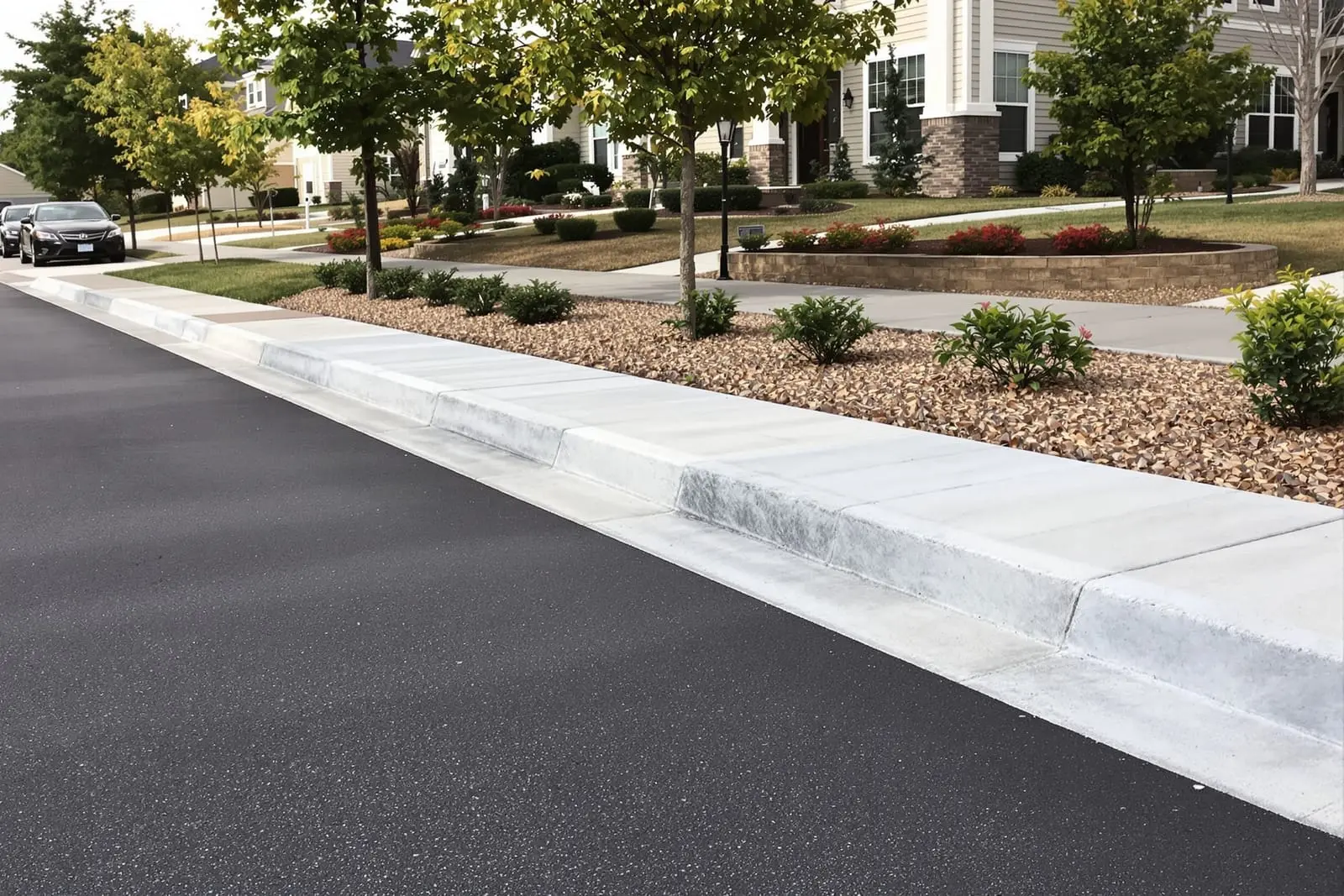
Control traffic and drainage with concrete curb and gutter installation in Omaha, NE. We form and pour curbs around parking lots, drives, and landscaped islands. Integral gutters and concrete barriers help guide water and vehicles where they need to go on your site.
Primetime Concrete Omaha provides professional concrete curb and gutter throughout Omaha, NE and the surrounding area. Our licensed, insured crew delivers safe, clean, on-time work with a free estimate before anything begins. Call (402) 838-2266 or request your free quote.
Practical Concrete Curb, Gutter & Barrier Solutions in Omaha
Curbs, gutters, and concrete barriers do more than frame a driveway or parking lot. In Omaha, they control storm water, protect pavement from breaking apart at the edges, and keep vehicles where they belong. Primetime Concrete Omaha focuses on building these features to handle our freeze-thaw cycles, heavy pickup trucks, and snowplow blades that are common across Douglas and Sarpy Counties.
We work on residential driveways in older neighborhoods like Benson and Dundee, commercial lots near West Dodge, and new construction in the suburbs. Each of those needs a different curb profile, thickness, and reinforcement. For example, a small neighborhood church lot might need standard curb and gutter with a few transition points for ADA access, while a trucking facility off I-80 may require thicker, doweled curbs and heavy-duty concrete barriers that stand up to trailer impact.
When you call Primetime Concrete Omaha about concrete curb and gutter work, we start with a site visit. We look at slopes, where water is currently collecting, how close you are to the street or alley, and what vehicles are using the area. We also check how your existing pavement was built, since curb and gutter that is too thin or not properly tied into the slab will crack away from it. The goal is not just to install concrete, but to build an edge system that protects your investment and keeps you in line with local drainage expectations and, when needed, city specs.
How We Install Concrete Curb and Gutter in Omaha
Our curb and gutter installation process is systematic so the finished concrete performs for years.
1. Layout and grade check: We set stringlines to mark the curb face and gutter line, then shoot grades with a laser level. In Omaha, even a small mistake in slope can leave ice patches where meltwater refreezes. For most projects we aim for a consistent gutter slope that moves water to inlets or away from structures without creating tripping hazards.
2. Excavation and base prep: We remove failed curb, sod, and soft subgrade, usually 8 to 18 inches deep depending on traffic loads. Then we compact the subgrade and, if needed, install a base layer of compacted crushed rock. In areas with clay-heavy soil, common around Millard and Ralston, we pay special attention to compaction because soft pockets under the gutter are a major cause of settlement and cracking.
3. Forms and reinforcement: We set steel or wood forms to match the profile you need, such as vertical curb, rolled curb, or curb and gutter combination. For commercial or high-traffic residential drives, we often add rebar dowels tying the curb into the pavement or install a rebar cage in barrier walls. This reduces separation where water can get in and freeze.
4. Concrete placement and finish: We use a mix designed for exterior flatwork, usually 4,000 to 4,500 psi, with air entrainment to handle winter freeze-thaw. Concrete is placed, vibrated where needed, and hand-shaped with curb tools to create a smooth face and consistent gutter. We add contraction joints at proper spacing and use an edge tool along the top to reduce chipping when snowplow blades ride along it.
5. Curing and protection: Proper curing is crucial in Omaha weather. We apply curing compound or use wet curing methods depending on temperature and wind. We also recommend keeping vehicles off new curb and gutter for at least 7 days, and we can place barricades if the area is close to regular traffic.
Every step is documented on site, which helps if you need proof of construction quality for a commercial property owner, HOA, or lender.
Concrete Barrier Options for Driveways, Parking Lots, and Commercial Sites
Concrete barriers are not just highway dividers. On private property in Omaha, they are often the difference between a minor bump and a vehicle in a storefront or down a slope. Primetime Concrete Omaha installs barrier systems that match how the site is actually used, not just what looks good on paper.
For small businesses, we often pour continuous low-profile barriers along storefronts or walkways. These are designed to stop slow-speed parking lot impacts and keep vehicles off sidewalks. Around loading docks or dumpster pads, we build taller, thicker barriers that tolerate repeated contact from trucks and skid loaders.
On multifamily properties and townhome communities, we commonly install parking bumpers as part of a broader barrier plan. In many cases, we recommend cast-in-place concrete stops tied into the slab, rather than loose blocks, because they stay aligned and hold up better to Omaha winters and plowing. Where there are drop-offs or steep embankments, we may design a reinforced barrier curb or wall that meets local safety guidelines and still allows for drainage.
Material choices matter here too. Barrier concrete uses higher strength mixes, heavy reinforcement, and deeper footings where impact loads are expected. We also consider visibility. For example, we can finish barriers with a broom texture and add chamfered edges so corners are less prone to break off. On commercial sites, we often suggest integrating barrier layout with striping and signage so drivers get clear visual cues before they ever reach the barrier.
By combining curbs, gutters, and barriers into a single layout plan, we can reduce the number of cuts and joints, manage water correctly, and avoid odd dead-end sections that crack or get hit by plows.
Design Choices, Cost Factors, and Common Problems We Solve
Most owners only install concrete curb and gutter once, so it helps to understand what affects cost and performance.
Design and profile: Straight runs of standard curb and gutter cost less than complex layouts with tight radiuses, multiple drain inlets, or decorative features. Rolled curb that is easier to drive over can work for many Omaha homes, but on commercial lots near busy corridors we often recommend a more vertical face for better vehicle control.
Thickness and reinforcement: Heavier traffic needs thicker sections and more steel. A curb and gutter serving a residential driveway might be 6 inches thick, while one at a warehouse entrance may need 8 or more with rebar. The extra material and labor add cost, but skipping them usually leads to edge breakup and costly patching a few winters later.
Subgrade and drainage issues: If your site has existing drainage problems, like the common puddles near alley aprons in midtown Omaha, we may need to regrade more area, add base rock, or slightly adjust elevations. That can increase labor time and hauling. Leaving poor grading in place will almost always cause your new curb or gutter to settle or heave, especially along older asphalt lanes.
Access and removals: Tight backyards in older neighborhoods, or work in busy parking lots that can only be done in off hours, can influence pricing. Removing old reinforced concrete or thick asphalt also takes more time and disposal.
Common problems we see include curbs that have separated from the driveway, gutters that hold water instead of draining, and curbs that are too low so snowmelt runs into garages. Our approach is to find the root cause, not just patch the symptom. For example, if repeated cracking is tied to downspouts dumping water behind a curb, we may recommend adding underground drains or redirecting roof runoff along with the curb replacement.
What Omaha Property Owners Should Know Before Hiring a Curb & Gutter Contractor
Choosing the right contractor for concrete curb and gutter work in Omaha comes down to a few key checks.
Ask how they handle winter conditions. Our freeze-thaw swings and use of de-icers are hard on exterior concrete. Primetime Concrete Omaha uses air-entrained mixes, proper joint spacing, and curing methods suited to local temperatures. We are realistic about when work can be done in shoulder seasons, and we will tell you if weather makes a pour too risky.
Confirm they understand local drainage and street tie-ins. Tying into city sidewalks, alleys, or streets often requires specific elevations so water flows correctly and lip heights meet accessibility expectations. We regularly work with city specs and can adjust our forms to match existing public concrete while still getting your on-site drainage right.
Look at how they plan traffic and site use. For homes, that might mean planning temporary parking so you are not stuck without a driveway longer than necessary. For businesses, it includes staging work in phases so parts of your lot stay open, clear signage for customers, and temporary barriers or cones so vehicles do not hit freshly poured edges.
Ask for details on materials and reinforcement instead of just a lump sum. You should know the planned concrete strength, thickness, use of rebar or dowels, and how they will handle joints and transitions where new curb meets old pavement. A specific written scope makes it easier to compare bids and ensures everyone knows what is included.
Finally, ask about warranty and realistic expectations. Properly installed curb, gutter, and barriers will last many years, but no concrete is maintenance free. We explain how to keep de-icing chemicals off fresh concrete the first winter, how to seal joints if needed, and what kinds of hairline cracking are normal versus what needs attention. That clarity upfront helps you get the longest life from your project.
“
Professional curbs, gutters & concrete barriers, done right the first time, quality materials, honest pricing, and results that last.
Primetime Concrete Omaha
Curbs, Gutters & Concrete Barriers Across Our Service Area