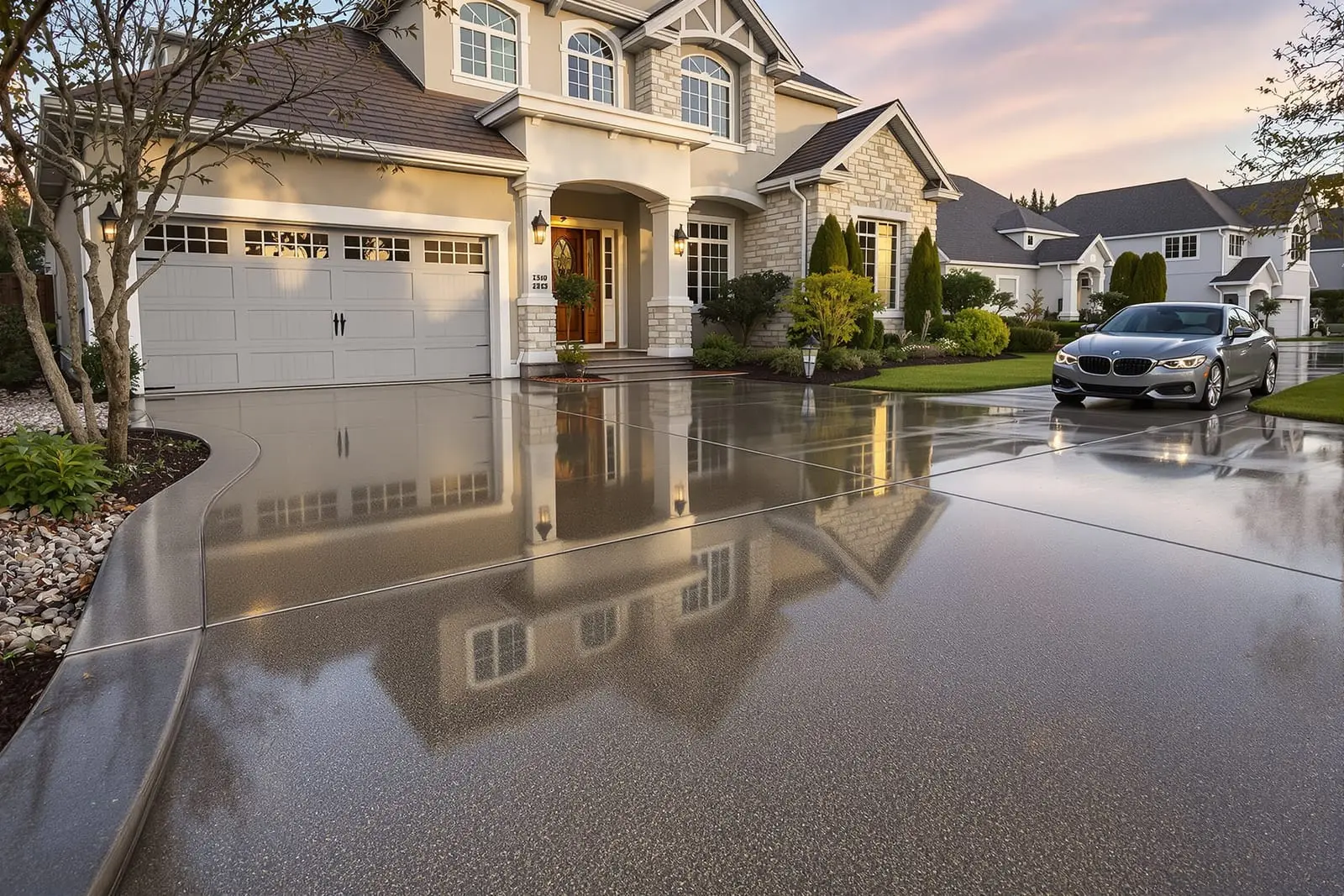
Protect your investment with professional concrete sealing in Omaha, NE. We clean and seal driveways, patios, and decorative surfaces to resist moisture and deicing salts. Routine maintenance keeps concrete looking sharp and helps prevent premature cracking and surface damage.
Primetime Concrete Omaha provides professional concrete sealing throughout Omaha, NE and the surrounding area. Our licensed, insured crew delivers safe, clean, on-time work with a free estimate before anything begins. Call (402) 838-2266 or request your free quote.
Concrete sealing in Omaha that matches our weather and soil
Concrete in Omaha takes a beating from freeze-thaw cycles, road salt, and clay-heavy soil that moves when it gets wet and dry. Primetime Concrete Omaha focuses concrete sealing and maintenance on these local conditions so your driveway or patio does not start flaking and cracking after a couple of winters.
When we look at a project, our first step is to figure out what the concrete is dealing with every year. A north-facing driveway that stays shaded and icy needs a different sealing plan than a sunny backyard patio or a warehouse floor that sees forklift traffic. We ask about snow removal methods, salt use, and water drainage around the slab. Those answers, plus what we see on site, determine which sealer type, how many coats, and what maintenance cycle we recommend.
Unlike a quick roll-on from a big-box store, we treat sealing as part of a system. That means checking expansion joints, drainage slopes, and any active cracks before we ever open a bucket of sealer. If the concrete is still moving or letting water in from below, any sealer will fail early. Our goal is not shiny concrete for a month. Our goal is an approach to sealing and maintenance that makes sense for your specific property on this side of Nebraska.
How our concrete sealing process actually works
Primetime Concrete Omaha follows a detailed process so the sealer bonds correctly and lasts as long as possible.
1) Inspection and moisture check: We walk the slab, mark spalling, pop-outs, and scaling, and pay attention to areas where de-icing salt has collected in past winters. If we suspect high moisture coming through the slab from below, we perform a simple plastic sheet test or use a moisture meter. This is important because many film-forming sealers will blister or turn cloudy if moisture is pushing up.
2) Deep cleaning and prep: We start with a high-pressure wash using the right tip to remove grime without etching the surface. Oil and grease spots are pre-treated with degreasers and scrubbed. For older or heavily scaled concrete, we may do a light mechanical prep with a floor machine and diamond pads to open up the surface. Any loose or flaking concrete is removed so we are sealing sound material, not debris.
3) Repairs before sealing: Hairline cracks are cleaned and filled with flexible crack fillers. Wider cracks and small pits are repaired with polymer-modified repair mortar. If your joints have deteriorated, we re-cut or clean them and install fresh joint sealant. Sealing over open joints or active cracks only traps problems, so we fix them first.
4) Sealer selection and application: For exterior driveways and walks in Omaha, we usually recommend a penetrating silane or silane-siloxane sealer that repels water and salt without forming a slick film. For decorative stamped or colored concrete, we often use an acrylic sealer that enhances color and can be made more slip resistant with fine grit. We apply the sealer by low-pressure sprayer, roller, or both, depending on the surface texture. Coverage rates are carefully followed, since putting it on too heavy can cause peeling or cloudiness.
5) Curing and follow-up: Most sealers are dry to the touch in a few hours, but we advise staying off the surface with vehicles for 24 to 48 hours. We leave written care guidelines so you know what de-icers are safe, when to wash, and when to plan your next maintenance visit.
Types of concrete sealers and which one you actually need
Not every concrete sealer suits Omaha’s climate or your specific surface. Primetime Concrete Omaha helps you avoid choosing a product based only on a label in the store.
Penetrating sealers: These include silane, siloxane, and blended products. They soak into the concrete and chemically bond with the pores. They are our default for driveways, sidewalks, entryways, and parking pads. They do not change the texture much, which keeps surfaces less slippery in winter. They are especially effective at resisting de-icing salts used heavily around Omaha.
Acrylic film-forming sealers: These sit on the surface and are common on stamped patios, colored concrete, and pool decks where customers want a richer color. They can be water-based or solvent-based. Water-based versions have less odor and are often a good fit for residential neighborhoods. Solvent-based versions deepen color more and can be more durable, but they need stricter ventilation and application controls. On any acrylic, we often add a fine anti-slip additive so snow and rain do not turn the surface into a hazard.
High-performance coatings: For garages, shops, and some commercial spaces, we may recommend epoxy or polyaspartic systems instead of a basic sealer. These are thicker coatings that require more surface prep, including grinding, but they stand up better to hot tires, motor oil, and heavy traffic. They cost more up front but can pay off on high-use floors where simple penetrating sealers are not enough.
Before we start, we explain the pros, cons, expected lifespan, and appearance changes for each option so you know what you are getting, not just what looks good on day one.
What drives the cost of concrete sealing in Omaha
Pricing for concrete sealing and maintenance is not one-size-fits-all. Primetime Concrete Omaha bases its estimates on a few key factors that we explain clearly before you commit.
Surface condition: Clean, relatively smooth concrete with minor wear costs less to seal than a driveway full of deep cracks, oil-soaked areas, and scaling. Repairs, degreasing, and grinding take time and materials, so they increase the bill, but they also prevent a quick, cheap job from failing and costing you more later.
Square footage and layout: A straightforward 3-car driveway is faster and more efficient to seal than a narrow, cut-up walkway system with multiple levels and steps. Odd shapes, many edges, and landscaping that requires protection add labor time. When we measure, we factor in both total area and how workable that area is.
Product choice and coat count: Penetrating sealers are usually a single coat and more budget friendly. Decorative acrylics may need two coats for even coverage and appearance. High-performance shop or garage coatings involve multiple layers, including primers and topcoats, and are priced accordingly.
Accessibility and timing: Working in tight alleys, on steep slopes, or on downtown commercial sites can slow down the crew. Seasonal timing also matters. Spring and fall are high-demand periods in Omaha, but we do not raise prices simply because the calendar is full. Instead, we may recommend scheduling slightly earlier or later to get better conditions and apply some off-peak discounts when possible.
Our written estimates outline the prep steps, repair items, product type, and estimated life cycle. That way you can compare more than just a square-foot price when choosing a contractor.
Concrete maintenance: what you should do between professional visits
Even the best concrete sealing needs basic care to perform well. Primetime Concrete Omaha walks customers through specific maintenance steps that matter in our local climate.
Winter de-icer choices: We strongly recommend avoiding products with ammonium nitrates or ammonium sulphates, which aggressively attack concrete. Standard rock salt (sodium chloride) is less damaging, but it still pulls moisture into the slab. The safest approach is to combine sand for traction with moderate use of gentler de-icers labeled safe for concrete, then sweep up leftover material once things dry.
Cleaning routine: For driveways and patios, a low-pressure rinse a few times a year, plus a mild detergent wash where vehicles park, does a lot to extend the life of the sealer. Oil and transmission fluid should be cleaned within a day or two, not weeks later. On coated garage floors, we recommend a soft broom and mop rather than harsh wire brushes that can scratch the coating.
Monitoring high-risk areas: Keep an eye on the bottom of driveways near the street, where plowed salt slush sits, and on shaded slabs that hold snow and ice. If you see new flaking, bubbling, or areas that seem to stay dark and damp longer than the rest, those are signs the sealer may be breaking down in that zone.
Resealing intervals: In Omaha’s climate, penetrating sealers on driveways typically need refreshing every 3 to 5 years depending on traffic and salt exposure. Decorative acrylic sealers on patios may need a new coat every 2 to 4 years, particularly on south-facing surfaces with strong sun. During a quick site check, we can pour a small amount of water on the surface and see how it behaves. If it soaks in quickly instead of beading, it is time to plan the next sealing.
Why Omaha homeowners and businesses choose Primetime Concrete Omaha
Sealing and maintaining concrete is not just a side service for us. Primetime Concrete Omaha works with concrete every day, which means we see what actually holds up on our streets, drives, and yards after ten or fifteen winters.
Local problem solving: We regularly handle calls about driveways that started scaling after only a couple of years, usually due to a combination of aggressive de-icers and poor initial sealing. In many of these cases, we can stabilize the surface by removing loose material, performing patch repairs, and switching to a more suitable penetrating sealer. For decorative patios that have turned dull, cloudy, or peeling because of incompatible sealers, we often strip failing layers, correct moisture issues, and rebuild the system with a breathable acrylic.
Straightforward recommendations: If we think a simple penetrating seal is all your standard gray driveway needs, we will not push a high-priced coating. If the concrete is in bad enough shape that sealing is a temporary band-aid, we explain that too so you can decide whether to maintain for a few more years or budget for replacement.
Clear scheduling and access planning: Omaha weather can move from sunny to rain to frost in the same week. We watch the forecast carefully, schedule sealing during proper temperature and humidity windows, and keep you updated if we need to adjust a date. For busy households and businesses, we plan traffic control and access routes so you are not stuck without parking or entry longer than necessary.
If you want concrete sealing and maintenance done with a realistic view of Omaha conditions, not a generic national script, Primetime Concrete Omaha is set up for that kind of work.
“
Professional concrete sealing & maintenance, done right the first time, quality materials, honest pricing, and results that last.
Primetime Concrete Omaha
Concrete Sealing & Maintenance Across Our Service Area